
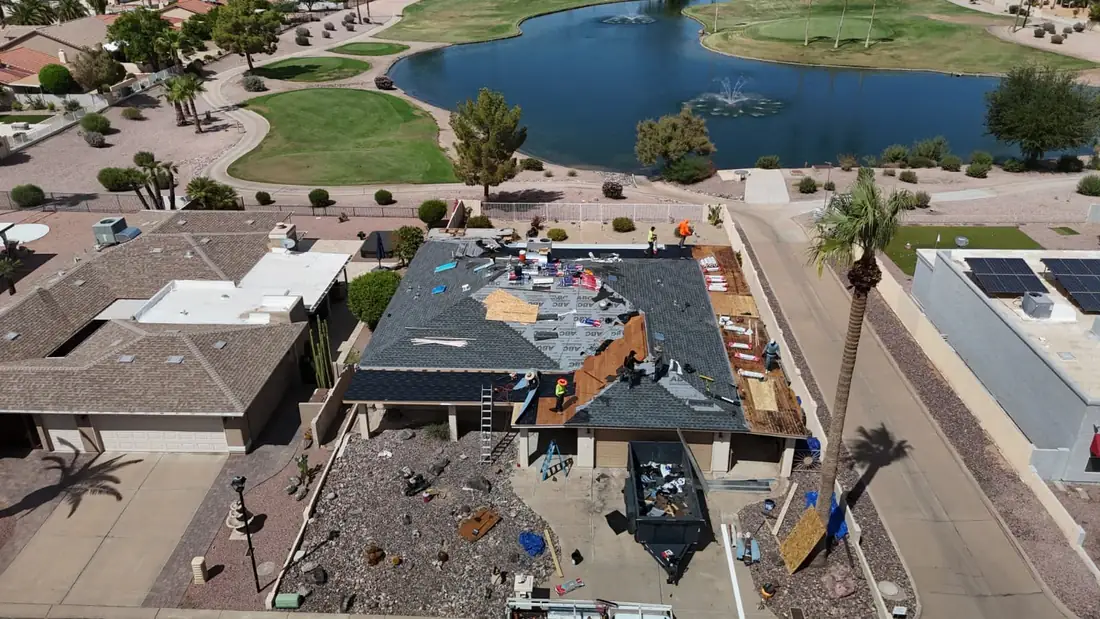
A Scottsdale flat-roof scupper leak after monsoon rain is a useful location clue, not a final diagnosis. Rain may enter at the outlet flashing, a parapet or coping detail, a crack or opening in the roof surface, a nearby penetration, or another location upslope. Water can then follow the deck, insulation, wall, or framing before it becomes visible. A dependable scope traces that complete route instead of covering the outlet with another unverified patch.
What to record safely after Scottsdale monsoon rain
Stay inside while lightning, damaging wind, hard rain, or blowing dust is active. Do not climb onto a wet, hot, or damaged roof. The National Weather Service Phoenix office warns that monsoon storms can bring damaging wind, dust, flash flooding, lightning, and rapidly changing hazards. Keep away from downed electrical lines, loose debris, unstable walls, and water near electrical fixtures.
From inside, start with wide photographs that show the entire ceiling or wall, then take closer images of drips, stain edges, bubbling paint, damp corners, or water at a window or door opening. Record when the rain began, when the symptom first appeared, whether it changed with wind direction, and how long it continued after the storm. Put a container beneath an active drip only if the area is safe, and move people and belongings away from sagging finishes or electrical hazards.
From the ground, photograph the wall below the scupper, downspout or collector when present, parapet line, roof edge, and any visible overflow. A camera zoom may capture stains, debris, displaced material, or water tracks, but a ground-level photograph cannot confirm the flashing or roof surface. OSHA guidance stresses keeping ladders free of slipping hazards; after a storm, leave rooftop access and ladder work to trained professionals.
- Date, time, and duration of rain before the first interior symptom
- Whether moisture appeared during wind-driven rain or after steady rain
- Wide and close interior photographs with a consistent reference point
- Exterior wall stains or water tracks below the scupper opening
- Visible overflow, debris, displaced material, or water leaving another outlet
- The location of roof drains, secondary scuppers, downspouts, and parapet walls
- Recent coating, flashing, HVAC, solar, or other rooftop work
- Previous leak locations, patches, invoices, warranties, and inspection photos
Why the scupper location does not prove the leak source
A scupper is an opening through a wall or edge that lets water leave a low-slope roof. It normally depends on a continuous transition between the roof surface, the opening, the wall, and the exterior discharge. The visible outlet is only one part of that assembly. Water may reach the same area from a parapet crack, coping joint, puncture, seam, equipment curb, blocked drain, low spot, or older patch.
Water also moves inside assemblies. The first ceiling stain may sit away from the opening, while an exterior streak below a scupper can result from ordinary discharge rather than leakage. The inspection should therefore separate three questions: how water is intended to reach the outlet, whether the outlet and wall transition remain watertight, and whether another path is feeding the same symptom.
Seven scupper, parapet, and drainage clues after monsoon rain
1. Water or debris remains at the scupper opening
Leaves, sediment, roofing granules, loose coating, bird debris, or displaced material can slow drainage at an outlet. Standing water beside the opening does not prove the scupper leaked, but it increases the time water contacts nearby seams and transitions. Photographs should show the outlet, the approach to it, surrounding low areas, and any secondary drainage route.
2. A new stain or water track appears below the exterior opening
Fresh staining, peeling finish, damp masonry, or a water track below the scupper deserves comparison with older photographs. Some exterior wetting can come from normal discharge, splash, or wind, so the pattern should be connected to the opening and the storm rather than diagnosed from one mark. The wall and any collector head or downspout should be included in the review.
3. Flashing, coating, or membrane separates at the opening or corners
Cracks, lifted edges, open seams, blisters, exposed foam, torn membrane, separated sealant, or damaged metal around the opening can interrupt continuity. All sides and corners matter. The correct repair depends on the installed roof system, substrate, moisture condition, and compatible materials; another surface bead of sealant may hide the detail without restoring it.
4. Ponding or a low area sits upslope of the scupper
GAF building-science guidance explains that water drains more slowly on low-slope roofs and that positive slope is used to direct it toward drains or scuppers. A low area, settlement, blocked path, or poorly placed patch can leave water on the roof even when the outlet itself is open. The report should document where water remains, how far it extends, and whether the proposed work addresses the cause or only the visible outlet.
5. The symptom changes with storm direction or rainfall intensity
A leak that appears only during wind-driven rain may increase the importance of a parapet, coping, wall opening, or exterior transition. A symptom that develops after prolonged rainfall may increase the importance of drainage, ponding, saturation, or a slow entry path. Timing narrows the investigation, but it is not proof by itself.
6. Parapet, coping, or wall transitions show movement or damage
Open coping joints, cracks, loose metal, failed terminations, impact, surface deterioration, or previous wall patches can admit water near the scupper. The roof and wall responsibilities should be named separately in the proposal. A roof-only patch may not solve a wall source, while wall work must not interrupt the roof flashing below it.
7. The same area has been patched more than once
Repeated patches can signal that the original path was never confirmed, the repair material was incompatible, drainage kept stressing the same detail, or wet materials extended beyond the visible opening. Photograph and map every patch. A broader investigation may be more useful than adding another layer over an assembly whose boundaries can no longer be seen.
Do not walk a wet or storm-damaged flat roof to clear an outlet. Water, loose coating, sediment, electrical equipment, concealed soft areas, extreme heat, and unstable edges can make access hazardous. Record only what is safely visible and leave roof access to trained professionals after conditions are stable.
What a complete scupper leak inspection should include
A useful report begins with orientation photographs connecting the interior symptom to the roof area, slope direction, parapet, scupper, drains, penetrations, equipment, and adjacent walls. Mid-range images should show how water approaches and leaves each outlet. Close images should document the roof-to-scupper transition, every visible corner and seam, exterior discharge, coating or membrane condition, wall termination, and previous patch.
The inspector should identify the low-slope roof system and determine whether the scupper is a primary drain, secondary overflow, or part of a collector and downspout arrangement. GAF publishes scupper products and architectural details that illustrate the need to waterproof the wall opening and seal transitions. Those materials are not universal residential repair instructions; they show why the actual roof system, opening, slope, substrate, metal work, and manufacturer requirements must be identified first.
If diagnosis requires opening coating, membrane, flashing, wall finish, insulation, or deck material, the written scope should define who performs that work, how the opening will be protected, and what happens if wet or damaged materials extend farther. The report should distinguish confirmed defects, suspected paths, and conditions that remain concealed.
- Interior moisture map tied to the roof and exterior wall location
- Roof plane, slope, drainage path, low areas, and every nearby outlet
- Primary and secondary drainage roles where they can be identified
- Roof system, surface condition, seams, coating, membrane, and previous repairs
- Scupper throat, corners, metal, flashing, terminations, and exterior discharge
- Parapet surface, coping, wall transitions, penetrations, and equipment upslope
- Debris or restriction without disturbing evidence before documentation
- Moisture clues in insulation, substrate, deck, and wall materials when accessible
- Temporary protection needs and the permanent repair boundary
- Material compatibility, preparation, tie-ins, testing, and completion photos
Cleaning, focused repair, or broader drainage correction
Cleaning may fit when safe professional access confirms that debris is the only restriction, the roof surface and scupper transition remain serviceable, drainage returns after the obstruction is removed, and there is no evidence of a separate leak. The service record should still identify what was removed, show before-and-after photographs, and note any condition that deserves monitoring.
A focused repair may fit when the water path is reasonably bounded, surrounding material remains sound, moisture has not spread beyond the proposed area, and compatible materials can restore a continuous tie-in. The estimate should state which scupper sides, corners, metal, roof surface, parapet transition, coating, membrane, insulation, or deck materials are included.
Broader drainage or roof work may deserve discussion when ponding extends across a large area, several outlets or parapet details are affected, wet materials continue beyond the visible defect, surface deterioration is widespread, repeated patches obscure the assembly, or the roof does not provide a reliable stopping point. A broad recommendation still needs photographs, measurements, moisture evidence, and a defined boundary.
Questions to ask before approving a Scottsdale scupper repair
- What evidence identifies the scupper, roof surface, parapet, or another source?
- Where is the suspected entry point relative to the interior symptom?
- Is this a primary drain, secondary overflow, or another type of outlet?
- Were the complete upslope drainage path and all nearby outlets documented?
- What roof system, scupper detail, and wall transition are installed?
- Is debris the only restriction, or is ponding caused by slope or settlement?
- What material must be opened to inspect concealed moisture or damage?
- How will the opening and interior be protected during the work?
- Which roof, flashing, metal, wall, and drainage items are included?
- How will new material tie into sound existing roofing?
- What happens if wet insulation, deck, or wall damage extends farther?
- What completion photos, flow checks, warranties, and maintenance notes are included?
The Arizona Registrar of Contractors recommends verifying a contractor's license and using a detailed written estimate that addresses the work, price, permit responsibility, and other relevant terms. For a scupper-area leak, the estimate should also name drainage and wall boundaries, concealed-condition limits, material compatibility, and how added work will be approved.
Frequently asked Scottsdale scupper leak questions
Does water near a scupper prove the scupper is leaking?
No. Water can enter through the scupper flashing, the parapet, a roof-surface defect, a penetration, or another location upslope. The inspection should document the complete drainage path before naming the source.
Can cleaning a clogged scupper stop a flat-roof leak?
Cleaning may restore drainage when debris is the only restriction, but it will not repair separated flashing, damaged coating or membrane, wet materials, poor slope, or a failed wall transition.
When does a scupper problem need broader flat-roof work?
Broader work may be appropriate when ponding, widespread surface deterioration, wet materials, repeated patches, parapet damage, or an unreliable tie-in extends beyond one outlet.
Official sources and the next Scottsdale step
Review the National Weather Service Phoenix monsoon safety guide before documenting conditions after severe weather. For ladder-related safety context, see OSHA ladder safety guidance.
For low-slope drainage and scupper context, review GAF's guidance on mitigating water on roofs, its scupper overview, and the EverGuard architectural details manual. Manufacturer materials must be matched to the installed assembly and approved repair rather than treated as universal field instructions.
The City of Scottsdale home-improvement page provides current direction for property- and scope-specific questions. Before hiring, use the Arizona Registrar of Contractors consumer checklist, verify the license, and compare detailed written estimates.
For local service context, visit Quest Roofing's Scottsdale roofing page. Compare the related Scottsdale roof valley leak guide, the flat-roof ponding guide, and the Scottsdale tile and flat roof inspection guide. You can also review roof leak repair, learn about foam and flat roofing, or request a free inspection and written estimate.
Published by Quest Roofing, a Queen Creek-based roofing contractor serving Scottsdale and the Greater Phoenix area. Updated August 7, 2026.